
Reading
Reading is prioritised across our Trust and our school as we recognise the importance this plays in securing the life chances of all our children.
If our children cannot read well, they cannot access the full curriculum which means they will struggle to learn. We want all children to read fluently by the end of primary school so that they are confident and well equipped to flourish in their next stage of education and beyond.
Learning to read is an incredibly complex process for children and there are many strands of the English Language structure that have to be understood and mastered.
Reading well involves two main parts that work together:
1. Understanding What You Read (Language Comprehension)
This is about making sense of the words and ideas:
Knowing about the world (background knowledge)
Knowing word meanings (vocabulary)
Understanding grammar and sentence structure (which words to use in the correct order together with the right punctuation)
Thinking about what the text means by reading between the lines (working something out from clues in the text)
Knowing how stories and texts work (this usually develops from being frequently read to by an adult)
2. Reading the Words (Word Recognition)
This is about the mechanics:
Hearing and recognising the sounds that letters and combinations of letters make (phonological awareness)
Putting the sounds together to read words (decoding)
Recognising words quicklythat often don’t make sense when the sounds are put together (sight recognition)
How do we teach children to read?
To develop rich knowledge and skills; children are explicitly taught daily word reading. Alongside this, children are exposed to language comprehension through our ‘Talk Through Stories’. Word reading development is embedded into our phonics programme. Once children become more phonologically aware, the focus of reading shifts towards developing fluent reading.
What is Talk Through Stories?
Talk Through Stories is an approach designed to help young children develop language, comprehension, and vocabulary through structured story time sessions. This approach builds a strong foundation in language and literacy and supports children to develop crucial speaking and listening skills.
Key elements of this approach:
1. Story-Based Learning: Children engage deeply with a high-quality picture book over the course of a week or more.
2. Repetition and Discussion: The same story is read multiple times, with daily discussions to build understanding and confidence.
3. Vocabulary Development: Key words from the story are explicitly taught and reinforced through conversation and play.
4. Oral Language Skills: The focus is on talking - children are encouraged to describe, explain, and retell parts of the story using new vocabulary.
5. Comprehension Focus: Teachers guide children through the story structure, character motivations, and key themes.
How do we teach phonics?
We use Twinkl Phonics as our systematic, synthetic phonics programme (SSP). It is high quality and robust in its purpose. With a clear, structured progression through the programme, it allows all of our pupils to meet or exceed the expected standard.
The Twinkl Phonics approach combines rigorous progression with engaging learning materials. We believe that children learn best when they are enjoying their learning and that this comes from a mix of bright, fun and engaging lesson resources within a clear and systematic approach that builds on children’s skills daily.
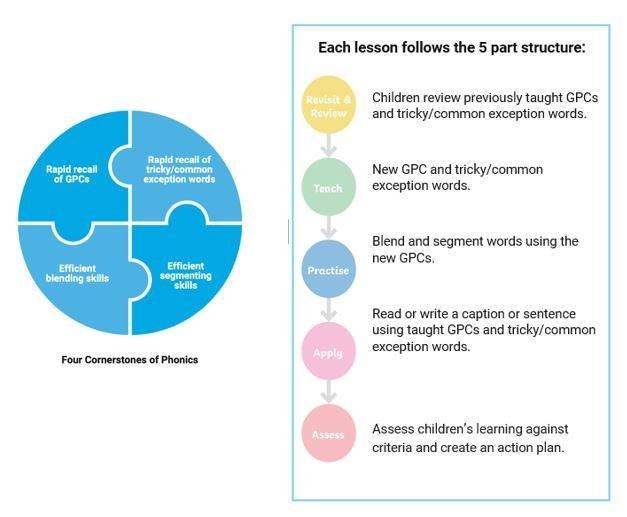
The structure of every Twinkl Phonics lesson follows this familiar five-part structure to ensure that the four cornerstones of phonics are covered. During our phonics lessons, children will repeat the elements from the four cornerstones of phonics to ensure that they have rapid and automatic recall of GPCs and tricky/common exception words; each day, they will experience blending and segmenting activities to allow regular practice of these core skills.
Stories are used to provide a stimulus and context for phonics teaching in our Twinkl Phonics lessons. The story content also integrates games to practise the skills taught. Our phonics lessons are also supported by weekly decodable minibooks, which are part of our core provision, where children can apply the skills they have learnt in their phonics lessons. As part of our wider SSP provision, there are also follow-up activities that the children can complete independently, in pairs or in groups that relate to the day’s learning.
Year 1 Phonics Screening Check
In the summer term, all children in Year 1 will undertake the National Phonics Screening Check. This is an assessment carried out in school during which the children will be assessed on their ability to segment and blend a range of 40 real and ‘alien’ words. Alien words are a selection of phonetically decodable nonsense words. The words in this assessment gauge the children’s understanding of the phonemes learnt and give the school the knowledge of where the gaps are. If the children are not secure in recognising, segmenting and blending these words and therefore do not pass the assessment, they will be offered further support as they enter Year 2 and will be able to repeat the assessment in the summer term of Year 2. This assessment also allows us to put in specific and personal support for those children who require additional assistance. If a child does not meet the expected standard in Year 2, then phonics teaching and learning will be continued into Key Stage 2.
In Year 1, once children have learnt a number of sounds and can put these together to read words, they need daily practice in reading. We use an approach called ‘scaffolded reading’. The teacher shows the children how to read at the right speed, use expression, and stop at the right places. They also model how to sound out words and put the sounds together. Children then read the text back to the teacher – this is called repeated reading. As the year progresses, children then begin to practise reading the text to partners while the teacher moves around the room ‘listening in’.
Once children have completed the phonics programme (usually during Year 2), they experience different types of reading lessons each aimed at developing fluent, confident readers:
· Fluency reading
· Extended reading
· Close reading
What do we mean by fluency?
Fluency means being able to read smoothly and understand what you are reading. A fluent reader can read words correctly, quickly and easily, and with expression.
· Accuracy: Reading words correctly without mistakes.
· Automaticity: Reading quickly and easily. How fast a child reads depends on their reading skill, purpose, and whether they read out loud or silently.
· Prosody: Reading with the right tone, rhythm, and expression—like natural speech.
Why fluency reading?
Teaching children to read fluently is essential because fluency serves as the bridge between decoding (sounding out words) and understanding them. When readers don't have to focus on decoding each word, they can better understand the text's meaning, make connections to what they already know, and build a mental picture of the text.
What do we mean by Extended Read?
An Extended Read is a structure for teaching reading that is designed to give children plenty of experience of the written English language.
Why Extended Read?
An Extended Read allows children to spend more time focusing on a longer text to improve reading fluency, vocabulary, and an understanding of the structure of the text. The aim is to help children build reading stamina and understand the main ideas of the text.
What do we mean by Close Reading?
Close Reading is a structure for teaching reading that is designed to engage children in deeper exploration of texts. A shorter piece of the current text is used to zoom into and discuss.
Why Close Reading?
The aim of Close Reading is to carefully consider the ways authors use language and the impact that this language has on different readers. Through the discussion of texts, children are encouraged to see that texts can be understood in different ways and that these views and opinions can be discussed.
How do we support children to develop reading for pleasure?
In our reading lessons we use high-qualtiy texts that introduce children to rich and varied vocabulary, a wide range of classic and contemporary authors, and interesting and engaging narratives. We are creating an exciting new Bridgeway library situated in The Ridge building where all children can regularly borrow books from a wide range of fiction and non-fiction books. Each classroom has a selection of books for children to enjoy during independent reading times.
Reception and Year 1 children are given a reading book to share at home that is linked to their Phonics Stage of learning. In Year 2 children continue bringing home a phonics book and also begin to bring a book banded reading book to take home so they can practise their reading. In Years 3-6 children are given a book banded reading book to bring home and may also receive a phonics book depending on their stage of learning.
Throughout the year we have several events to celebrate reading and further develop reading for pleasure. Our World Book Day activities, author visits, and book fairs along with staff sharing their own enjoyment of reading ensure our children develop a lifelong love of reading.