
Maths
Mathematics is a subject that enables children to understand patterns, solve problems and make sense of the world around them. Across our Trust, we are committed to ensuring that every child develops secure mathematical knowledge, confidence and fluency, providing the foundations for future success.
We know that strong mathematical understanding is built over time. For this reason, our Trust places particular emphasis on securing children's understanding of number and developing fluent recall of key mathematical facts from the earliest stages of education.
Successful mathematicians develop knowledge and skills in three key areas that work together:
1. Fluency
Fluency is the ability to recall and use key mathematical facts efficiently and accurately.
This includes:
Number bonds
Addition and subtraction facts
Multiplication and division facts
Recognising patterns and relationships between numbers
When children know important number facts automatically, they can focus their attention on solving problems and understanding new mathematical concepts.
2. Mathematical Understanding
This is about making sense of mathematics and understanding how numbers and concepts are connected.
Children develop their understanding by:
Exploring mathematical ideas
Making connections between concepts
Recognising patterns and structures
Explaining their thinking
Using mathematical language accurately
3. Reasoning and Problem Solving
This is about applying mathematical knowledge and understanding to solve problems.
Children learn to:
Explain their thinking
Justify their answers
Make predictions
Solve unfamiliar problems
Apply mathematics in different contexts
How do we develop strong mathematical foundations?
Across our Trust, we place significant emphasis on developing secure number knowledge from the very beginning of school. We believe that children's success in mathematics is built on strong foundations and fluent recall of key facts.
Early Number in Reception
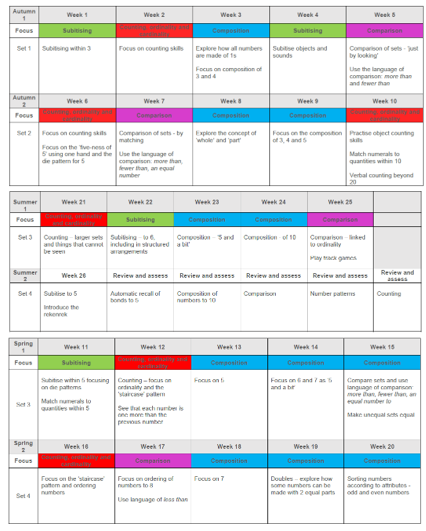
In Reception, children participate in the National Centre for Excellence in Teaching Maths (NCETM) Mastering Number Programme.
This programme is designed to develop a deep understanding of early number and focuses on securing strong foundations rather than rushing children on to larger numbers.
Children learn to:
Recognise and compare quantities
Understand numbers to 10 in depth
Recognise patterns in number
Develop confidence when working with numbers
Understand how numbers are made up and related to one another
These important early experiences provide the foundation for future learning in mathematics.
Building Secure Addition and Subtraction Facts
In Years 1 and 2, children continue with the NCETM Mastering Number Programme in addition to daily maths lessons. This programme develops their understanding of number alongside the fluent recall of key addition and subtraction facts.
Secure knowledge of these facts is important because it enables children to tackle more complex mathematics with confidence and accuracy.
Across the Trust, children's progress is monitored through our addition and subtraction recall programme. This allows teachers to identify strengths, address gaps in learning and provide support when needed, ensuring all children develop confidence and success with number.
Building Times Tables Fluency
In Key Stage 2, children participate in our Trust-wide Times Tables Programme.
We recognise that secure times tables knowledge is one of the most important foundations for later mathematics. When multiplication and division facts can be recalled automatically, children are able to focus on reasoning, problem solving and more advanced mathematical concepts.
Our programme provides regular, structured opportunities for children to practise and remember key multiplication and division facts. Children's progress is carefully tracked, and additional support is provided where needed, helping all children develop confidence and success in mathematics.
Why is mathematical fluency important?
Mathematical fluency helps children to become confident, successful learners.
When important number facts are known and remembered, children are better able to:
Solve problems efficiently
Focus on reasoning and deeper thinking
Make connections between mathematical ideas
Tackle new learning with confidence
Apply mathematics in everyday situations
How do we support children to be successful in mathematics?
Across our Trust, we believe that all children can be successful in mathematics.
Teachers:
Build new learning on secure prior knowledge
Carefully check children's understanding throughout lessons
Identify and address misconceptions quickly
Provide support and challenge where needed
Encourage children to explain their thinking
Celebrate effort, improvement and success
Our Mathematics Curriculum: NCETM curriculum prioritisation materials
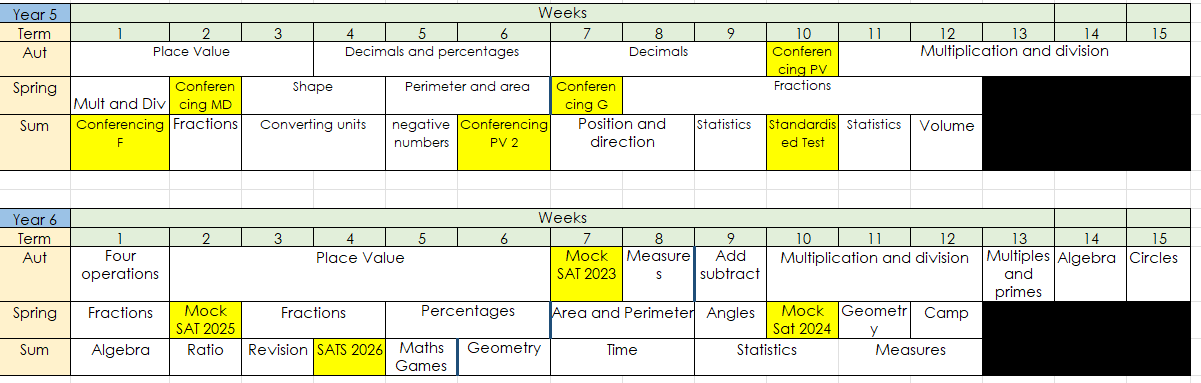
At Bridgeway Federation, we follow the National Curriculum for mathematics and work closely with the local NCETM Math Hub. We follow a Mastery approach to teaching mathematics, using the DFE Ready to Progress guidance as the basis to structure our curriculum throughout the school. This brings coherence to our curriculum by focusing on core concepts and demonstrating progression from year 1 to year 6. The mathematics curriculum focuses on the most important knowledge and understanding within each year group and the significant connections between these mathematical topics. This mastery approach ensures pupils spend sufficient time on each unit so they are secure in their conceptual understanding, before moving onto the next.
Curriculum Overviews
Reception:
Year 1:

Year 2:


DfE Ready To Progress Criteria
The DFE Ready to Progress document identifies the most important areas in mathematics that pupils need as they progress from year 1 to year 6. These important concepts are referred to as ready-to-progress criteria (RTP). The ready-to-progress criteria (RTP) have been selected in order to develop pupils’ mastery of the primary maths curriculum and, if all criteria are taught and met, pupils will be able to more easily access many other areas of mathematics.